
|

Geologic Time Scale

Geologic Time Scale

The Geologic Time Scale is an international system used by geologists to classify and identify major geologic events and formations. The geologic timescale essentially categories the earth’s entire geologic (and biologic) history, within a series of defined eons, eras, periods, epochs, and ages.

Updates & Maintenance

The geologic time scale is continuously modified and updated on the basis of breakthrough geologic research, data, and discoveries. The administration of this system is maintained by the Geologic Society of America, the International Union of Geological Scientists, the International Commission on Stratigraphy, and more. As of the year 2020, geologists understand the earth to be approximately 4.6 billion years in age. And the latest addition to the geologic time scale comprises a new “age,” referred to as the Meghalayan Age. This age signified by human-impact on the planet.

Geologic Time Scale by the Geologic Society of America

The image below references the geologic time scale published by the Geologic Society of America, as of the year 2020. Please click the image below to be re-directed to a PDF of the latest geologic time scale, directly from the Geologic Society of America website.
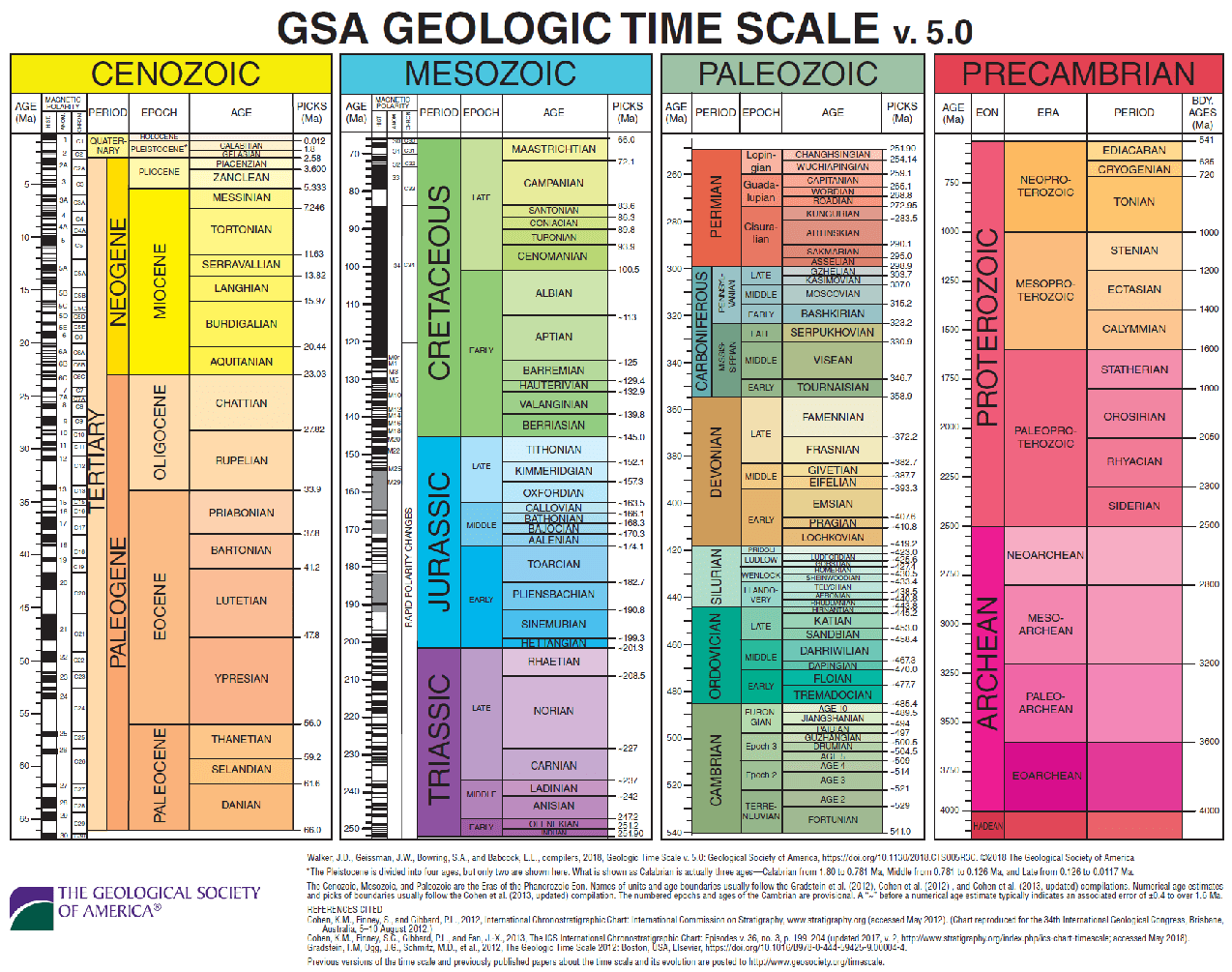
Geologic Time Scale by the Geologic Society of America

Geologic Time Scale by the International Union of Geological Scientists

The geologic time scale below is published by the International Union of Geological Scientists and is as recent as the year 2020. Please click the timescale below to be re-directed to a PDF of the latest geologic time scale, directly from the International Union of Geological Scientists’ website.
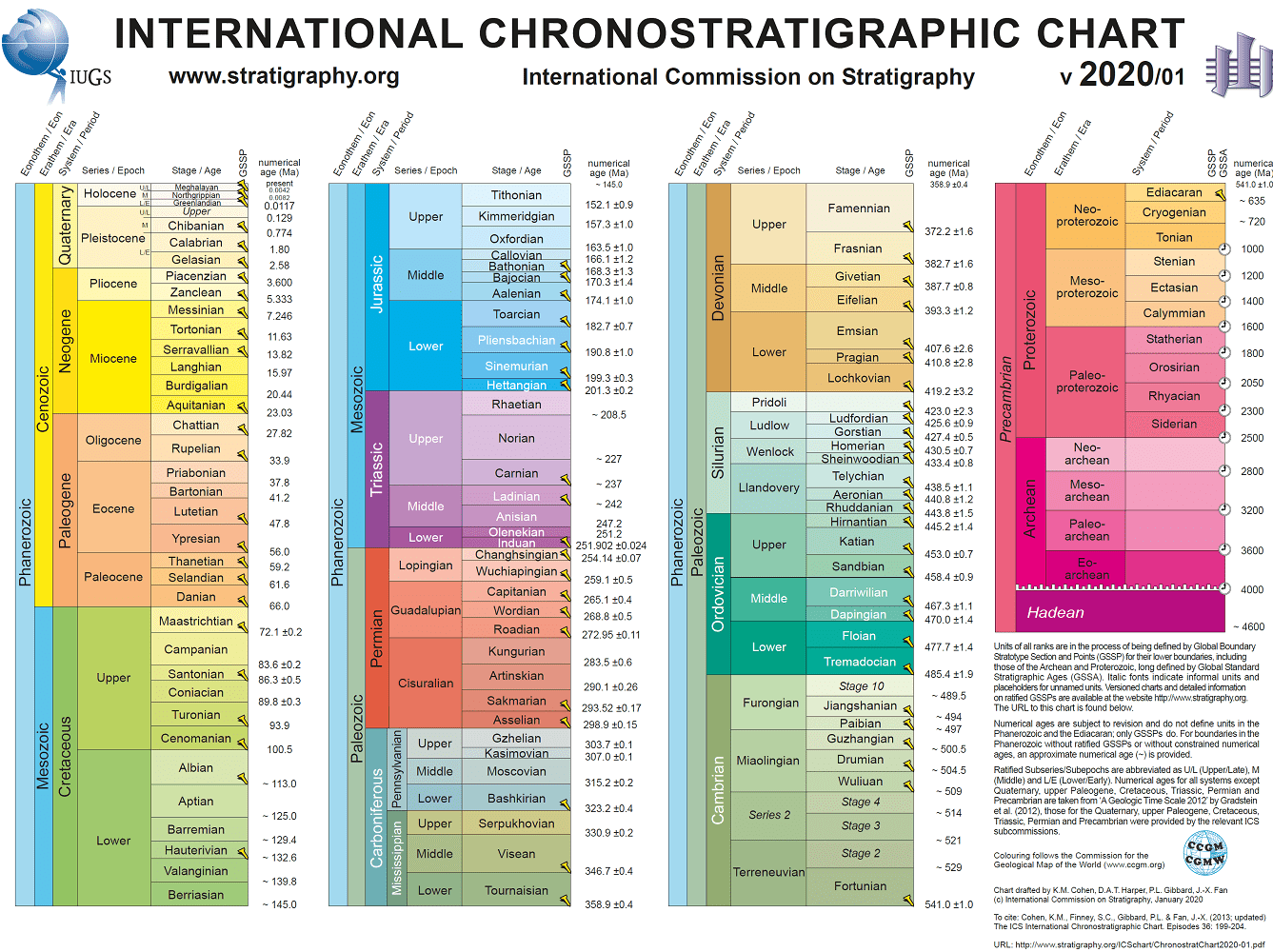

Geologic Time Scale by the International Union of Geological Scientists

Similar Posts

  • Stratosphere

    Stratosphere Stratosphere: The stratosphere of a terrestrial planet is the second-lowest member of the atmosphere. On Earth, the stratosphere starts atop the troposphere at approximately 10 kilometers above mean sea level, and terminates roughly 50 kilometers above mean sea level. In fact, geologists understand that the Earth’s ozone layer exists within the stratosphere, which absorbs…

  • |

    PCBs Contamination in Killer Whales and Orca Pollution

    PCBs Contamination in Killer Whales and Orca Pollution PCBs contamination in killer whales and orca pollution is an increasing concern in the environmental science community. Recent studies indicate hazardous levels of industrial chemicals exist in the bodies of orcas and other marine mammals, worldwide. In fact, toxicologists now hypothesize that rising concentrations of carcinogens like…

  • Dry Strength

    Dry Strength “Dry Strength” is a value that represents the strength of a soil sample, when dry, as determined by the crushing test. There is a common geotechnical engineering laboratory procedure for determining the cohesiveness or plasticity of a sample with organic or inorganic clays and silts.  

  • Natural Gas

    Natural Gas Natural Gas: In geology, natural gas means combustible hydrocarbon gas that forms by natural geological or biological processes. To illustrate, natural gas that forms by geological processes is the thermal decomposition of buried organic materials. Whereas natural gas that forms via biological processes entail the microbial decomposition of buried organic material. Natural gas…

  • Well Graded

    Well Graded Soil Well Graded: In the soil classification process of geology, well graded soil represents a sedimentary soil sample that fully displays all of the possible grain sizes for that soil classification, in accordance with the Unified Soil Classification System (USCS). For example, a well graded sand (SW) comprises fine, medium, and coarse grains…

  • U-Shaped Kitchen

    U-Shaped Kitchen U-Shaped Kitchen: A U-shaped kitchen, or a horseshoe kitchen, is a general kitchen plan layout with counters, walls, and cabinets that generally form a square-like or rectangular-like shape of the letter “u.”  In the State of California (and other states with similar building code standards), U-shaped kitchens must have a minimum of 60-inches…