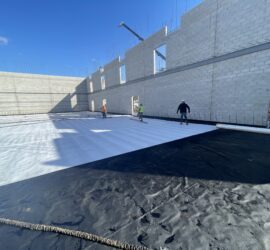
De-watering System

De-Watering System in Methane Mitigation

De-Watering: In accordance with the Los Angeles Department of Building and Safety (LADBS) Methane Code, Ordinance Number 175790, a de-watering system is a permanent water removal system in a methane mitigation system. In the mitigation process, a de-watering system consists of perforated horizontal pipes, gravel pockets, sump areas with pumps, and a discharge point. These systems intend to permanently maintain the groundwater level to at least one foot below the impervious membrane. Meanwhile, it allows for methane soil gas to continuously enter the vertical riser pipes for proper health and safety measures to the lowest occupied space.


Similar Posts

  • Terrestrial Planet Definition

    Terrestrial Planet Definition A terrestrial planet is any planet in the universe that has earth-like composition, such as rocks, and other similar solid substances. For instance, Mars is a terrestrial planet in our solar system, whereas Jupiter is not. This is because modern geologists, astrophysicists, and astronomers understand Mars to contain solid formations correlative to…

  • Milliequivalent per liter

    Milliequivalent per liter Milliequivalent per liter (meq/L): A unit used to express the chemical equivalence of the concentration of solutes in a solution. It is calculated by dividing the concentration of a substance (in mg/L) by its equivalent weight. This measurement helps in understanding the reactive capacity of ions in the solution.

  • Liquid Limit (LL)

    Liquid Limit (LL) “Liquid Limit (LL)” in the field of geological engineering, refers to the upper limit of the “plastic state.” This is a separation of the plastic phase and viscous liquid phase when measuring soil consistency. Mathematically, it is the water content (basing on the percent of dry weight), at which two sections of…

  • Volcanic Rock (Igneous)

    Volcanic Rock (Igneous) Definition A “Volcanic Rock” is an igneous rock that is finely crystalline and glassy (or aphanitic). To illustrate, volcanic rocks result from volcanic action at the earth’s surface. Typically, this also includes igneous intrusions that are “near-surface,” which may otherwise be considered plutonic. This action results in a final rock that is…

  • Translational Slide Definition

    Translational Slide Landslide Translational Slide: In the seismology branch of geology, a translational slide is a type of landslide movement that occurs predominantly along a planar surface. Alternatively, this movement can occur along gently undulating surfaces. For instance, the Palona Schist metamorphic bedrock on the eastern embankment of the former St. Francis Dam comprises an…