Vent Riser in Methane Mitigation

Vent Riser in Methane Mitigation

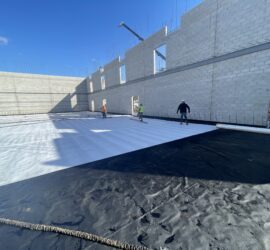
Vent Riser in Methane Mitigation: As per the Los Angeles Department of Building and Safety (LADBS) Methane Code, Ordinance Number 175790, a vent riser is a cast iron or ABS pipe that runs through the building walls (vertically). A vent riser is part of a methane mitigation system and has joints and fittings that connect to the perforated horizontal pipes under the impervious membrane. This device conveys methane soil gas from under the methane barrier, and discharges it into the atmosphere.


Similar Posts

  • Regression

    Regression Regression: In geology, regression is the formation of a specific sequence of sedimentary and metamorphic layers, that are the result of ocean water withdrawing from the land. To illustrate, when regression occurs over millions of years, geologists find a layer of limestone, overlain by shale, and overlain again by limestone. The opposite of regression is…

  • Liquid Limit (LL)

    Liquid Limit (LL) “Liquid Limit (LL)” in the field of geological engineering, refers to the upper limit of the “plastic state.” This is a separation of the plastic phase and viscous liquid phase when measuring soil consistency. Mathematically, it is the water content (basing on the percent of dry weight), at which two sections of…

  • Alquist-Priolo Earthquake Fault Zoning Act

    Alquist-Priolo Earthquake Fault Zoning Act Alquist-Priolo Earthquake Fault Zoning Act: The Alquist-Priolo Earthquake Fault Zoning Act is a law that assists geologists to define “active faults” versus “potentially active faults.” The process entails using the same aging criteria as the United States Geological Survey (USGS) and the California Geological Survey (CGS). In fact, California policy requires…

  • Rock Stratigraphic Unit

    Rock Stratigraphic Unit In the field of geology, a rock stratigraphic unit, or a lithostratigraphic unit, is a geologic formation that is identifiable by a specific lithology, as well as a consistent stratigraphic position. For example, the Monterey Formation is a rock stratigraphic unit, as it tends to consistently comprise the same gravel and sand…

  • Milliequivalent per liter

    Milliequivalent per liter Milliequivalent per liter (meq/L): A unit used to express the chemical equivalence of the concentration of solutes in a solution. It is calculated by dividing the concentration of a substance (in mg/L) by its equivalent weight. This measurement helps in understanding the reactive capacity of ions in the solution.