Unobstructed Opening in Methane Mitigation

Unobstructed Opening Definition in Methane Mitigation

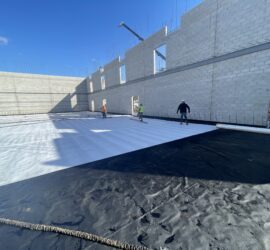
Unobstructed Opening: Per the Los Angeles Department of Building and Safety (LADBS) Methane Code, Ordinance Number 175790, an unobstructed opening is a permanent clearance or gap in the walls, floors, or ceiling of a structure, to allow for direct fresh airflow. In methane mitigation plan applications, this does not include windows, skylights, or doorways. Furthermore, the Methane Code, indicates that some structures in Methane Zones and Methane Buffer Zones with large enough unobstructed openings may be eligible for exceptions to the impervious membrane and methane barrier requirements. Although the exception does not apply in all cases.


Similar Posts

  • Engineering Geology & Geological Engineering

    Engineering Geology or Geological Engineering Engineering Geology: Engineering geology is also referred to as “geological engineering,” and is a branch of geology that relates to the study of earth materials and processes, that are juxtaposed to proposed structures such as buildings, retaining walls, dams, roads, pipelines, and more. Whereby geologists assess any potential levels of…

  • Igneous Rock

    Igneous Rock Definition In the field of geology, the term “Igneous Rock” refers to one of the three major classifications of rock that comprises the earth. As opposed to sedimentary rocks or metamorphic rocks, igneous rock derives from the direct cooling and solidification of magmatic material. Igneous rock comprises a large amount of the planet…

  • Rotational Slide (Slump)

    Rotational Slide (Slump) Definition Rotational Slide (Slump):  A rotational slide is a type of landslide movement that occurs in a turning moment, about a pivot point that is above the center of gravity. This is typically due to an increased normal force on a slope, as well as a reduced cohesion factor of the soil…

  • Contact Metamorphism

    Contact Metamorphism Contact Metamorphism – Metamorphism is associated with the intrusion of an igneous mass. Metamorphic changes are caused principally by heat, but also by magma composition and deformation related to the intrusion. Pressures are relatively low (<3000 bars) while temperatures range from 200°C to 1000°C.

  • Seismology

    Seismology Seismology: (seis·mol·o·gy) a branch of geology and geophysics that relates to earthquakes, including but not limited to their causes, effects, hazards, and mitigation techniques.  Seismologists at the United States Geological Survey (USGS) use cutting-edge technology to measure seismic wave properties and geological hazards that trigger them or are triggered by them. In turn, seismology…