Waterproofing Barrier System

Waterproofing Barrier System Definition

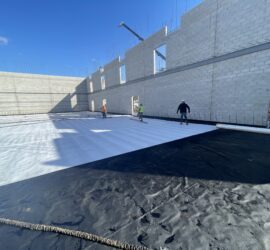
A waterproofing barrier system guarantees full protection to walls, foundations, and methane mitigation systems that are below grade and are susceptible to moisture penetration. Typically, the best way to protect a retaining wall against moisture is the application of a waterproofing barrier on the backside of it, after pouring concrete, but before backfilling soil. And the same applies to building footings and stem walls. However, with horizontal sub-slab applications, a waterproofing barrier system is installed prior to pouring the concrete slab.

Applications of a Waterproofing Barrier System & Membrane

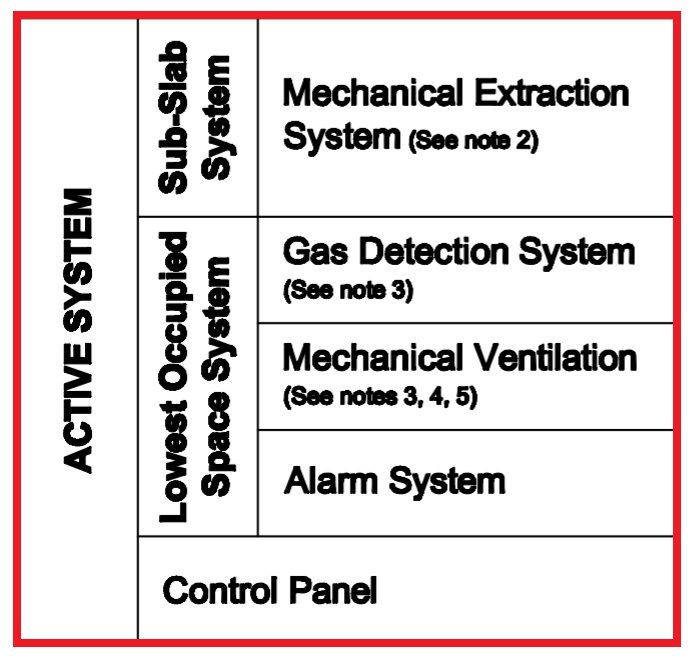
A waterproofing barrier system is not equivalent to a de-watering system. Although in some cases, a waterproofing barrier can be part of an elaborate de-watering system. Moreover, a methane vapor barrier, which is necessary as part of the methane mitigation process, can also sometimes be a waterproofing barrier, depending on the application, make, and model of the membrane.


Similar Posts

  • Igneous Rock

    Igneous Rock Definition In the field of geology, the term “Igneous Rock” refers to one of the three major classifications of rock that comprises the earth. As opposed to sedimentary rocks or metamorphic rocks, igneous rock derives from the direct cooling and solidification of magmatic material. Igneous rock comprises a large amount of the planet…

  • Volatile Organic Compounds (VOCs)

    Volatile Organic Compounds (VOCs) Volatile Organic Compounds (VOCs): Volatile Organic Compounds are toxic organic chemicals with higher tendencies to change from liquid to vapor phase under typical earth pressures and temperatures, and usually have little-to-no water solubility characteristics. VOCs are commonly found within hydrocarbon-based fuel additives, industrial solvents, refrigerants, hydraulic fluids, degreasers, and more. These…

  • Extrusive Rocks

    Extrusive Rocks Extrusive Rocks: In the volcanology branch of geology extrusive rocks are igneous rocks that have been erupted onto the Earth’s surface, before forming and crystallizing. On the other hand, intrusive rocks form and crystallize under the Earth’s ground surface. Extrusive rocks are typically microcrystalline and aphanitic, because of the faster rate of cooling…

  • Sedimentary Rock

    Sedimentary Rock Definition In geology, the term “Sedimentary Rock” refers to the classification of rock that is the result of the gradual consolidation and deposition of loose particles of other rock classifications (igneous or metamorphic). Alternatively, sedimentary rocks can also form by the accumulation and precipitation of other natural chemical solutions in a depositional environment….