Waterproofing Barrier System

Waterproofing Barrier System Definition

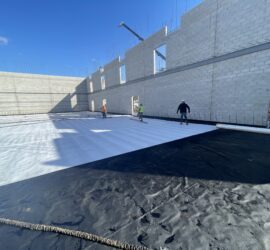
A waterproofing barrier system guarantees full protection to walls, foundations, and methane mitigation systems that are below grade and are susceptible to moisture penetration. Typically, the best way to protect a retaining wall against moisture is the application of a waterproofing barrier on the backside of it, after pouring concrete, but before backfilling soil. And the same applies to building footings and stem walls. However, with horizontal sub-slab applications, a waterproofing barrier system is installed prior to pouring the concrete slab.

Applications of a Waterproofing Barrier System & Membrane

A waterproofing barrier system is not equivalent to a de-watering system. Although in some cases, a waterproofing barrier can be part of an elaborate de-watering system. Moreover, a methane vapor barrier, which is necessary as part of the methane mitigation process, can also sometimes be a waterproofing barrier, depending on the application, make, and model of the membrane.

Similar Posts

  • Perforated Horizontal Pipe

    Perforated Horizontal Pipe in Methane Mitigation Perforated Horizontal Pipe: As per the Los Angeles Department of Building and Safety (LADBS) Methane Code, Ordinance Number 175790, a perforated horizontal pipe is a PVC or ABS pipe that contains a series of small holes or narrow openings placed equidistantly along the length of the pipe, and is…

  • Darcy’s Law

    Darcy’s Law In the field of geology, Darcy’s Law is the universal and basic equation representing groundwater flow through a study area. Darcy’s Law Formula Q = KiA The following variables and coefficients apply to this formula: “K” = Hydraulic Conductivity; “Q” = Discharge Rate; “A” = Area of Cross-Section that Water Flows;

  • Milliequivalent per liter

    Milliequivalent per liter Milliequivalent per liter (meq/L): A unit used to express the chemical equivalence of the concentration of solutes in a solution. It is calculated by dividing the concentration of a substance (in mg/L) by its equivalent weight. This measurement helps in understanding the reactive capacity of ions in the solution.

  • Focus (Hypocenter)

    Focus (Hypocenter) Focus (Hypocenter): In the seismology branch of geology, a focus, or hypocenter, refers to the specific place where an earthquake rupture originates. The focus, or hypocenter, underlies the epicenter when an earthquake occurs at a dip-slip fault, strike-slip fault, oblique-slip fault, or listric fault. In the event of an earthquake, geologists, and seismologists…

  • Hydrogen Sulfide Soil Gas

    Hydrogen Sulfide Soil Gas (In Natural Gas) Hydrogen Sulfide: Hydrogen sulfide (H2S) soil gas geologically occurs upon the thermal and microbial decomposition of subsurface organic material deposits. It is typically identifiable in biogenic and petrogenic natural gas sources, along with higher concentrations of methane soil gas. Additionally, nitrogen, oxygen, hydrogen, ethane, and isobutane exist within…

  • Fault Scarp

    Fault Scarp Fault Scarp: In the field of geology, a dip-slip fault scarp is a steep slope that is formed directly by fault movement. It occurs along the line of a normal fault, reverse fault, or transform fault. A fault scarp represents the planer surface of the fault before erosion and weathering modify it.