Landfill Gas Testing & Monitoring
Landfill gas testing is the evaluation of methane soil gas which forms from the decomposition of organic waste underground. Over time, it can move through soil and seep into nearby buildings. For this reason, our professional geologists and engineers test soil gas near active and closed landfills. As a result, property owners, developers, and agencies get clear data on fire, explosion, and health risks.
What Is Landfill Gas?
Landfill gas is a natural byproduct of decomposing trash. First, bacteria break down food, paper, wood, and yard waste. Then, as oxygen runs out, they produce methane and carbon dioxide. Landfill gas is typically about half methane and half carbon dioxide. It also carries small amounts of other compounds, such as volatile organic compounds (VOCs) and hydrogen sulfide.
Older landfills often carry extra risk. Before modern disposal rules took hold in the 1990s, many sites accepted solvents and industrial waste along with household trash. Consequently, gas from these sites may contain toxic chemicals besides methane. In short, the waste in the ground shapes the gas that comes out of it. In addition, a landfill can keep producing gas for decades after it closes.
How Landfill Gas Moves Into Buildings
Soil gas is the vapor that fills the tiny spaces between soil grains. Gas naturally flows from areas of high pressure to areas of low pressure. Therefore, landfill gas often spreads sideways, away from the waste and under nearby properties.
It travels fastest along easy pathways. For example, sand and gravel layers, utility trenches, and sewer lines all act as channels. Once gas reaches a building, it can enter through slab cracks, pipe openings, and gaps in walls. Falling barometric pressure can also pull more gas out of the ground.
Methane is colorless and odorless, so people usually get no warning. For instance, a home or restaurant built near a former dump could slowly collect gas in enclosed rooms without anyone noticing.
Health and Safety Risks of Landfill Gas
Explosion and Fire Hazards
Methane burns easily at the right concentration. CalRecycle notes that landfill gas can create methane concentrations between the lower and upper explosive limits (5% and 15%), which may cause explosion hazards or oxygen-deficient conditions. Within that range, a light switch, pilot light, or spark can trigger an explosion. Sadly, these disasters have happened before. In 1986, landfill gas destroyed a home in Loscoe, England, and the case changed how landfill gas is managed.
Toxic Vapor Exposure
Trace chemicals in landfill gas create a separate risk. Some VOCs, such as benzene and vinyl chloride, are known carcinogens. These risks usually build through long-term exposure. Even so, they matter for the health and safety of everyone inside a building.
Landfill Gas Regulations in California
California regulates landfill gas under Title 27 of the California Code of Regulations. CalRecycle and Local Enforcement Agencies (LEAs) require monitoring of landfill gas (LFG) to determine if LFG is migrating beyond the site. Under these rules:
- The concentration of methane gas must not exceed 1.25% by volume in air within any portion of any on-site structures.
- Methane migrating from the landfill must not exceed 5% by volume in air at the property boundary.
- Monitoring plans must account for adjacent land use and inhabitable structures within 1,000 feet of the permitted facility boundary.
Perimeter gas probes are commonly checked every quarter. In addition, building departments may require soil gas testing before new construction near a landfill.
How Landfill Gas Testing Works
Every landfill site is different. Still, most investigations follow four steps:
- Records review. We study landfill boundaries, disposal history, and past monitoring data.
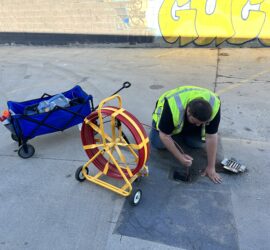
- Probe installation. Next, we install soil gas probes and perform a methane soil gas survey at set depths between the landfill and the property.
- Field measurements. Then, we measure methane, carbon dioxide, oxygen, and gas pressure with calibrated instruments. Lab analysis confirms the results when needed.
- Reporting. Finally, we deliver a report with clear findings and next steps, such as mitigation design or methane detection and alarm systems.
Is your project near an oil field or in a City of Los Angeles Methane Zone instead? If so, see our methane soil gas survey page.
Talk to a Geologist About Landfill Gas
Do you have questions about landfill gas near your property or project? Call (888) 930-6604 to speak with a licensed professional geologist. You can also schedule a consultation online with the Geo Forward consultation tool.
Related Methane Services
Need help with a property in a methane zone? We provide methane testing, methane mitigation design and plan check support, and certified methane deputy inspectors for construction. Call (888) 930-6604.
Sources
- CalRecycle – Landfill Gas Monitoring Plan Review Approach
- LA County DPW – Gas Monitoring and Control Regulations
- CalRecycle – Landfill Gas Investigations
Technical Review
Founder & Licensed Professional Geologist
Geo Forward, Inc.
Last Updated: November 2026