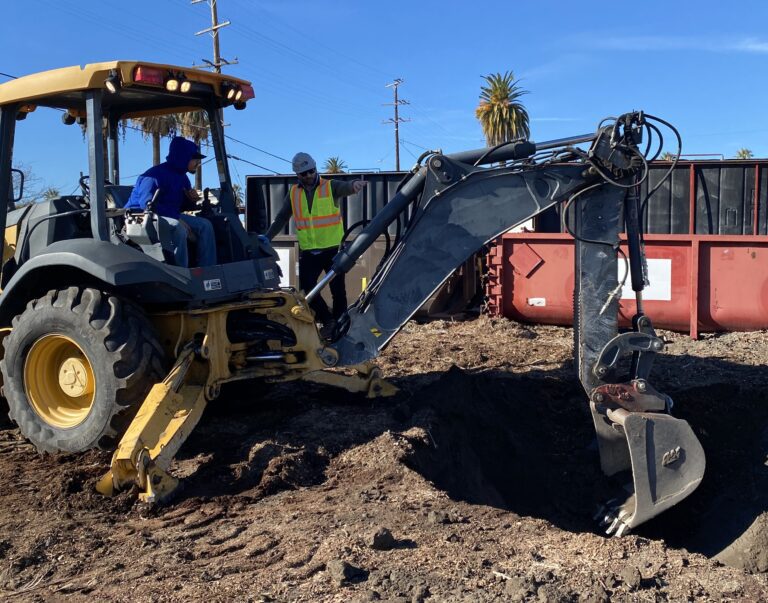
Orange County methane testing helps developers and property owners find hidden gas risks before they build. Much of the county sits on or near historic oil fields. As a result, methane can travel through soil and collect inside buildings. Our licensed professional geologists run soil gas investigations that meet local fire and building department rules. Then we help you move from testing to permit approval.
Why Orange County Has Methane Risks
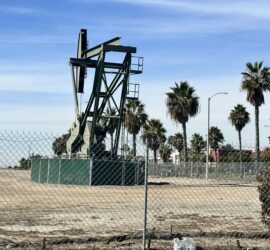
Oil drilling shaped Orange County. For example, Brea’s own guideline explains that the City of Brea is bounded on the south by the Coyote Petroleum Reservoir, and to the north by the Brea-Olinda Petroleum Reservoir. In addition, the Brea-Olinda reservoir is characterized by vertical fractures in bedrock and oil and gas seeps at the surface. Huntington Beach, Newport Beach, Seal Beach, and Yorba Linda also sit near oil fields.
Old wells add to the danger. In October 2025, Newport Beach declared a local emergency due to hazardous conditions at a residential home on the Balboa Peninsula. Officials linked the methane to oil intrusion from an abandoned private oil well beneath the property. In all, seven homes were evacuated on Balboa Peninsula over worries about the risk of an explosion. Events like this show why methane testing matters before construction begins.
Orange County Methane Testing Rules by City
Orange County has no single methane code. Instead, each fire authority or city sets its own standard. Therefore, the right testing plan depends on where your project sits.
OCFA Guideline C-03
The Orange County Fire Authority publishes Guideline C-03, Combustible Soil Gas Hazard Mitigation. The current edition is dated January 1, 2017. It covers OCFA member cities such as Santa Ana, Seal Beach, Stanton, Tustin, Villa Park, Westminster, Yorba Linda, and Unincorporated Areas of Orange County. Under C-03, a soil gas investigation may be required for sites within 300 feet from any gas seepage zone, or within 1000 feet from the refuse footprint of a landfill. Also, Yorba Linda projects follow Yorba Linda Policy 26. In practice, C-03 testing usually involves installation and monitoring of multiple-depth, subsurface methane gas probes.
Huntington Beach Methane District
Huntington Beach runs its own fire and building codes. Projects there must show that the site complies with City Specifications 429, Methane District Building Permit Requirements and 431-92, Soil Quality Standards. In addition, the city’s building code includes Chapter 55 Methane District Regulations.
Newport Beach Methane Overlay Zone
Newport Beach created a methane gas mitigation district in 1990. Its purpose is to require property owners to test for, and mitigate, the presence of methane gas prior to significant new construction. The Newport Beach Methane Overlay Zone applies where studies have shown there is a distinct possibility of high concentrations of methane gas in soil close to ground surface.
Brea, Placentia, and Other Cities
The City of Brea Combustible Soil-Gas Guideline covers investigation, mitigation, monitoring, and long-term maintenance. Likewise, Placentia now publishes its own Combustible Soil Gas Hazard Mitigation Guideline through Placentia Fire & Life Safety.
How Orange County Methane Testing Works
Every jurisdiction has its own details. Still, most projects follow the same basic steps:
- Records review. First, we check oil field maps, abandoned well records from the California Geologic Energy Management Division (CalGEM), and nearby landfills.
- Work plan. Next, we confirm the testing scope with the fire authority or building department.
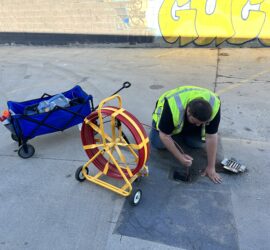
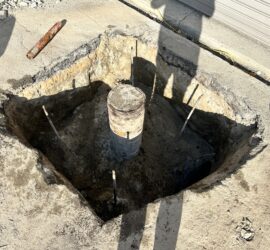
- Probe installation. Then, we install soil gas probes at multiple depths across the site.
- Field monitoring. We measure methane concentration and gas pressure with calibrated instruments. Weather matters here, because, according to ASTM, a falling barometer may leave soil gas under pressure.
- Report and next steps. Finally, we deliver a stamped report. If the results call for it, we design methane mitigation systems or plan remediation.
To learn more about the testing process itself, visit our main methane soil gas survey page.
Why Methane Gas Is Dangerous
Methane has no color or odor. Brea’s guideline warns that combustible soil-gases, such as methane, can seep into structures and explode if a source of ignition is present. Gas often moves along easy paths, such as utility trenches, gravel layers, and old well casings. For background on a landmark Southern California case, see this Stanford University paper on the 1985 Ross store methane explosion.
Schedule Orange County Methane Testing
Do you have a project in Huntington Beach, Newport Beach, Brea, Yorba Linda, or anywhere in Orange County? Call (888) 930-6604 to speak with a licensed professional geologist. You can also book a consultation with the Geo Forward consultation tool.
Sources
- OCFA Guideline C-03 – Combustible Soil Gas Hazard Mitigation
- Placentia methane assessment report citing C-03
- City of Brea Combustible Soil-Gas Guideline
- Huntington Beach Fire Code (Spec 429 reference)
- Huntington Beach Title 17 – Chapter 55 Methane District
- Newport Beach Chapter 15.55 Methane Overlay Zone
- City of Newport Beach – local emergency notice
- LAist – Methane vented from under Newport Beach home
- ASTM E2993 – Combustible soil gas guide
Technical Review By
Founder & Licensed Professional Geologist
Geo Forward, Inc.
Last Updated: November 2026