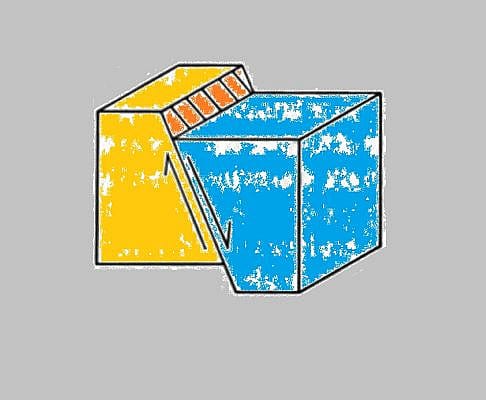
Dip-Slip Fault Definition

Similar Posts

  • Liquefaction

    Liquefaction Liquefaction: Liquefaction is the process by which there is: (1) a sudden and significant decrease of shear resistance in a soil sample (cohesion-less); (2) a sudden (but temporary) increase of the pore-water pressure of a substance; and (3) a solid mass of soil that is transformed into a fluid state mass. In the event…

  • Biogenic Gas

    Biogenic Gas Biogenic Gas: In geology, biogenic gas refers to natural gas that is the byproduct of the microbial decomposition of biological and organic matter. For instance, methane soil gas on Earth is typically a biogenic gas resulting from the decomposition of organic soil zones, landfills, marshes, and swamplands. Alternatively, natural gas can be petrogenic…

  • Translational Slide Definition

    Translational Slide Landslide Translational Slide: In the seismology branch of geology, a translational slide is a type of landslide movement that occurs predominantly along a planar surface. Alternatively, this movement can occur along gently undulating surfaces. For instance, the Palona Schist metamorphic bedrock on the eastern embankment of the former St. Francis Dam comprises an…

  • Strike-Slip Fault (Transform Fault) Definition

    Strike-Slip Fault or Transform Fault Strike-Slip Fault (Transform Fault): In the field of geology, a strike-slip fault, or a transform fault, is a fault in which movement is parallel to the strike of the fault plane. The opposite of a strike-slip fault is a dip-slip fault. Left-Lateral or Right-Lateral Strike-Slip Fault A transform fault can…

  • De-watering System

    De-Watering System in Methane Mitigation De-Watering: In accordance with the Los Angeles Department of Building and Safety (LADBS) Methane Code, Ordinance Number 175790, a de-watering system is a permanent water removal system in a methane mitigation system. In the mitigation process, a de-watering system consists of perforated horizontal pipes, gravel pockets, sump areas with pumps,…

  • Water Table

    Water Table Water Table: In the hydrogeology branch of geology, the water table represents the surface of an unconfined groundwater aquifer, where the hydraulic pressure is equal to atmospheric pressure. Additionally, a water table is present in a perched groundwater zone. Although, there is no water table in a confined aquifer.