An environmental compliance audit is an independent review of a facility’s operations, permits and records to find environmental violations before a regulator does, and to fix them. Geo Forward provides environmental compliance audits and compliance consulting for businesses that store, handle or generate hazardous materials and waste, including manufacturers, auto shops, dry cleaners, warehouses, fuel sites and property owners. We tailor each audit and report format to the agencies that oversee your site. Call (888) 930-6604 or request a proposal.
Technical Review: Reviewed by Adam Azad Kaligi, PG (Licensed Professional Geologist) | Written by Michael Sabo, Technical Director | Last updated November 2026
The environmental compliance audit process – Geo Forward
Environmental Compliance Audit Services
Global (facility-wide) compliance audits covering all environmental and related safety programs
Programmatic audits focused on one area, such as hazardous waste, stormwater or underground tanks
Agency-required audits and periodic compliance reporting
Corrective action plans and follow-up verification
Compliance consulting for plans, training and recordkeeping
Why an Environmental Compliance Audit Pays Off
Environmental violations can lead to notices of violation, fines, cleanup orders and, for willful violations, criminal charges. An audit finds problems while they are still small, such as missing secondary containment under drums or expired training records, before they become a release or an enforcement case. The U.S. EPA’s Audit Policy, formally “Incentives for Self-Policing: Discovery, Disclosure, Correction and Prevention of Violations,” offers significant penalty reductions to companies that voluntarily discover, promptly disclose and correct violations. Audits also improve safety, efficiency and readiness for inspections, sales and refinancing.
What an Environmental Compliance Audit Covers
Program
What we check
Hazardous materials
Storage, labeling, secondary containment, spill kits and hazardous materials business plans
Hazardous waste
Generator status, container management, accumulation times, manifests and EPA ID numbers
Underground and aboveground tanks
Permits, leak detection, testing certificates, spill prevention plans and inspection records
Stormwater and wastewater
Permit coverage, pollution prevention plans, best management practices, sampling and drains
Air quality
Equipment permits, recordkeeping and operating conditions
Health and safety programs
Written plans, worker training, emergency procedures and good housekeeping
Records
Permits, inspection reports, agency correspondence and maintenance logs
Environmental Compliance Audit Checklist
Before the audit, gather:
All environmental permits and registrations
Hazardous materials inventory and business plan
Hazardous waste manifests and generator records for the last three years
Tank testing, leak detection and inspection records
Stormwater pollution prevention plan and sampling results
Training records and written safety plans
Recent agency inspection reports and notices of violation
Routine Compliance Audit Programs
Compliance is not a one-time event. Permits change, staff turn over and inspections come without notice. Geo Forward offers routine environmental compliance audits on a quarterly, semiannual or annual schedule, so problems are caught early and your records stay inspection-ready.
Agency-Required vs. Voluntary Audits
Agency-required (bureaucratic) audits are ordered by a regulator, often after past violations or for high-risk handlers of hazardous waste, and may come with periodic reporting. Voluntary (non-bureaucratic) audits are done by choice to find and fix problems in good faith. Voluntary audits can be programmatic, focused on one concern such as subsurface contamination, or global, covering every environmental and safety program. For most businesses, we recommend a global audit.
Who Regulates Your Facility
Federal: U.S. EPA
California: the Department of Toxic Substances Control (DTSC), the Air Resources Board and local air districts, and the State and Regional Water Boards
Local in California: Certified Unified Program Agencies (CUPAs), usually county or city fire or environmental health departments, such as the Los Angeles County Fire Department Health Hazardous Materials Division
Texas: the Texas Commission on Environmental Quality (TCEQ)
Our Environmental Compliance Audit Process
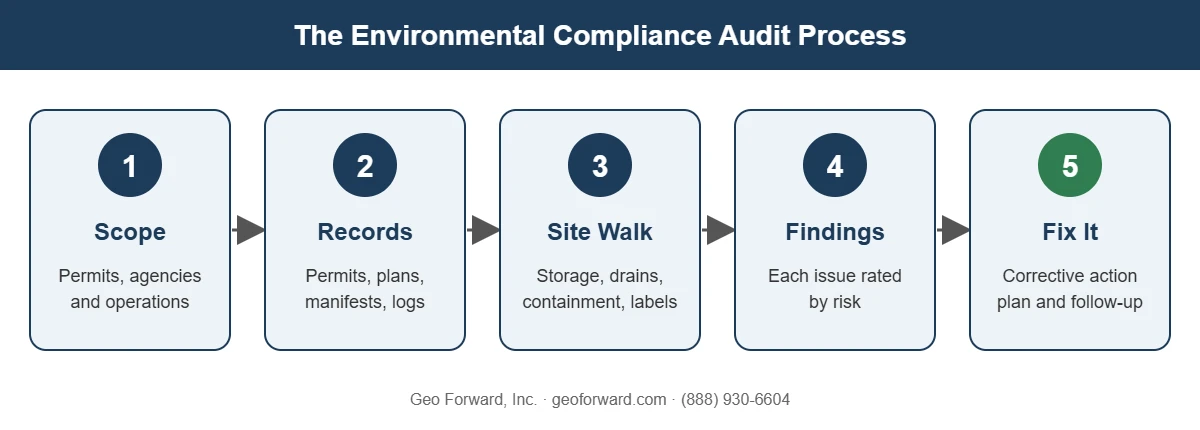
Scope: we identify your operations, permits and the agencies that apply.
Records review: permits, plans, manifests, inspection reports and logs.
Site walk: storage areas, drains, containment, labeling, tanks and waste areas.
Findings: each issue is described, photographed and rated by risk, from a near miss to an active release.
Corrective action plan: clear steps, owners and deadlines, with follow-up verification.
An environmental compliance audit typically costs $2,000 to $10,000, depending on the scope and the size of the facility. Cost depends on the size and complexity of the facility, the number of programs and permits, the number of sites and the reporting format you need. Call (888) 930-6604 or request a proposal for a fixed quote.
Why Choose Geo Forward
Environmental scientists who also investigate and clean up sites, so we understand what a finding can turn into.
Report formats customized to any agency’s structure.
California and Texas offices in Los Angeles, Pasadena, El Segundo, North Hollywood, Santa Clarita, San Francisco and Houston, with projects nationwide.
Environmental Compliance Audit FAQs
What is an environmental compliance audit?
It is an independent review of a facility’s permits, records and operations to find where it does not meet environmental laws and regulations, followed by a plan to correct each issue.
How often should a facility have a compliance audit?
Geo Forward offers one-time audits and routine audit programs on a quarterly, semiannual or annual schedule. Many companies also audit after major changes such as new processes, new permits or an ownership change. Agency-required audits follow the schedule in the order or permit.
Does a compliance audit reduce penalties?
It can. Under the EPA Audit Policy, companies that voluntarily discover, promptly disclose and correct violations may qualify for significant penalty reductions. The conditions are specific, so talk with counsel before disclosing.
What is the difference between an environmental audit and a Phase 1 ESA?
A compliance audit checks whether a business is following environmental rules. A Phase 1 ESA evaluates whether a property may be contaminated, for a purchase or loan. They overlap in records review but answer different questions.
Who needs an environmental compliance audit?
Any business that stores hazardous materials, generates hazardous waste, operates tanks, holds stormwater or air permits, or has received a notice of violation. Buyers of such businesses often order one before closing.
How much does an environmental compliance audit cost?
An environmental compliance audit typically costs $2,000 to $10,000, depending on the scope and the size of the facility. Routine quarterly, semiannual or annual audit programs are also available.
Orange County methane testing helps developers and property owners find hidden gas risks before they build. Much of the county sits on or near historic oil fields. As a result, methane can travel through soil and collect inside buildings. Our licensed professional geologists run soil gas investigations that meet local fire and building department rules….
This property condition assessment checklist shows what Geo Forward reviews on a commercial property and the seven steps we follow from scheduling to final report. Every property condition assessment (PCA) we perform follows ASTM E2018-24, adjusted to the lender’s or buyer’s scope of work. Technical Review: Reviewed by Adam Azad Kaligi, PG (Licensed Professional Geologist)…
Under LAFD Chief’s Regulation 4, each fire and life-safety system in a Los Angeles building has its own testing interval. Most systems, including methane gas detection, are tested every year. Standpipes, automatic sprinklers and full-flow pressure reducing valves also need a five-year test. Here is the complete Reg 4 testing frequency schedule and how to…
Environmental Law: the body of federal, state and local laws, regulations and court decisions that protect air, water, land, wildlife and public health from pollution and environmental harm. It shapes how property is bought, developed, used and cleaned up. Key Federal Environmental Laws CERCLA (Superfund): cleanup of hazardous substance releases and liability for contamination RCRA:…
False positive methane readings during soil methane testing are uncommon. In fact, in the event of an error, the more frequent concern involves false negative results. This is usually caused by analyzing equipment malfunction, probe leakage, atmospheric air intrusion, or improper sampling procedures. Inaccuracies in this process usually dilute methane concentrations for samples collected. As…